Product Introduction
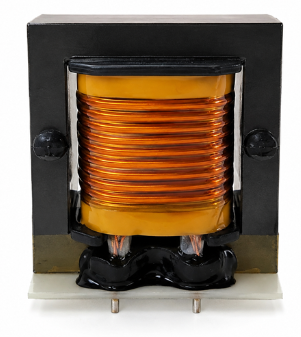
PQ Series high frequency transformer is designed around the characteristics of the PQ ferrite core, making it particularly suitable for power conversion equipment where board space, power density, thermal performance, and current capability must be considered together.
The PQ core geometry provides a favorable relationship between magnetic cross-sectional area and winding space. This allows the transformer to accommodate the winding requirements of medium- and higher-power switching circuits without requiring an excessively large component footprint. Common PQ core sizes include PQ26, PQ32, PQ35, PQ40 and other configurations selected according to the required power level and circuit design.
A notable feature of this series is its copper foil winding structure. For applications carrying relatively high current, copper foil provides a practical winding solution with good conductor utilization and helps manage losses associated with high-frequency operation. The winding arrangement can be adapted according to voltage ratio, current, insulation distance, and thermal requirements.
The transformer uses a PCB through-hole mounting structure, with the lower section reinforced by encapsulating material. This combination improves mechanical stability after assembly and helps the component withstand vibration encountered in industrial and new-energy equipment.
Rather than being intended as a general-purpose small transformer, the PQ Series is better suited to power stages where designers need greater power capability from a relatively compact magnetic component.
Key Specifications & Parameters
Product Name: PQ Series High Frequency Transformer
Product Type: PCB Mount High Frequency power transformer
Core Series: PQ Ferrite Core
Common Core Models: PQ26 / PQ32 / PQ35 / PQ40 and Other Available Sizes
Winding Structure: Copper Foil Winding
Mounting Type: PCB Through-Hole Mounting
Bottom Structure: Reinforced with Encapsulating Material
Power Range: Typically From Hundreds of Watts to Several Kilowatts, Depending on Core Size and Design
Operating Frequency: Customized According to Circuit Requirements
Electrical Parameters: Customized According to Voltage, Current and Power Requirements
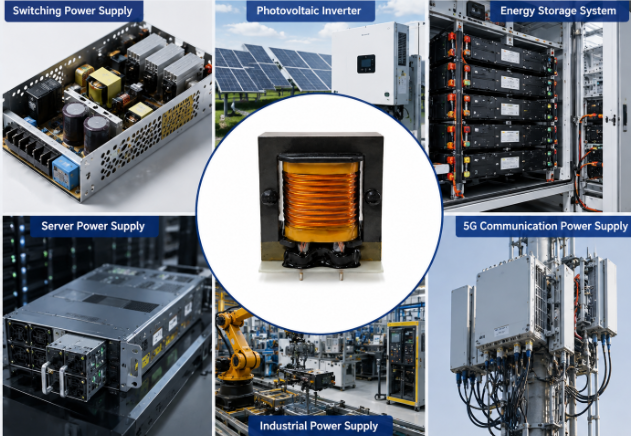
Application: Switching Power Supply, Energy Storage, Photovoltaic Equipment, Server Power Supply, 5G Communication Power Supply
Customization: Core Size, Winding Arrangement, Electrical Parameters and Mechanical Configuration Available According to Project Requirements
Main Functions
High-Density Power Transfer
The PQ core structure makes efficient use of the available magnetic and winding area, allowing the transformer to handle higher power levels without unnecessarily increasing the PCB footprint. This is particularly useful in compact power converters where component density is an important design consideration.
High-Current Winding Capability
Copper foil winding is suitable for circuits with demanding current requirements. Compared with conventional round-wire arrangements in certain high-current designs, the foil structure provides a larger conductor cross-section within the available winding space and supports practical thermal management.
High-Frequency Voltage Transformation
The transformer performs voltage conversion within high-frequency switching circuits. The winding ratio and magnetic design can be matched to the input/output requirements of the target power topology rather than being limited to a fixed standard configuration.
Primary-to-Secondary Isolation
Appropriate winding separation and insulation design provide electrical isolation between different sides of the power circuit. Insulation requirements can be considered according to the working voltage and safety requirements of the equipment.
PCB Direct Installation
Through-hole terminals allow the transformer to be mounted directly onto the PCB. This eliminates separate lead-wire routing and is suitable for power assemblies requiring a stable, repeatable component position during production.
Mechanical Reinforcement
Encapsulating material at the base helps secure the winding and core assembly, reducing movement under vibration or transportation conditions and improving structural stability in industrial equipment.
Specific Application Scenarios
Energy Storage Power Conversion
Battery energy storage equipment contains bidirectional and auxiliary power conversion stages that demand compact magnetic components capable of handling significant power. PQ transformers can be configured according to the voltage and current conditions of these converter circuits.
Photovoltaic Power Equipment
Solar power conversion systems require magnetic components capable of operating efficiently within high-frequency switching stages. The PQ core format is suitable for applications where designers need to balance transformer size, current handling, and available board space.
Inverter Power Stages
Inverter designs often place strict requirements on magnetic component dimensions and thermal behavior. PQ series transformers can be designed around specific switching frequencies and power levels for integration into inverter power assemblies.
Server Power Supplies
Server power architectures emphasize high power density because substantial output power must be delivered from limited PSU space. A compact PCB-mounted PQ transformer helps reduce magnetic component footprint while supporting demanding conversion stages.
5G Communication Power Supplies
Communication power equipment requires compact, continuously operating power modules. PQ Core Transformers can be integrated into high-density conversion assemblies where stable power transfer and efficient PCB utilization are required.
Industrial High-Power Switching Supplies
Industrial control cabinets, automation systems, and specialized power equipment can use PQ Series transformers in switching conversion stages requiring robust PCB installation and application-specific electrical characteristics.
FAQ
Q1: Why is a PQ core used for high-frequency power transformers?
A1: PQ cores provide a useful combination of magnetic cross-sectional area and winding space. This geometry makes them suitable for designs that require relatively high power capability while controlling the overall transformer dimensions.
Q2: What is the difference between PQ26, PQ32, PQ35 and PQ40 transformers?
A2: These designations refer to different PQ core sizes. Larger cores generally provide more magnetic and winding capacity, but the appropriate model should be selected according to power level, switching frequency, current, temperature rise, and available installation space rather than core size alone.
Q3: Why does this transformer use copper foil windings?
A3: Copper foil can be advantageous in high-current transformer designs because it makes effective use of the winding window and provides a large conductor cross-section. The final winding configuration should still be determined according to current, frequency, loss, and thermal requirements.
Q4: How is the PQ Series transformer installed on a PCB?
A4: The transformer uses through-hole terminals for direct PCB mounting. Its bottom section can also be reinforced with encapsulating material to improve mechanical stability after assembly.
Q5: What information is important when selecting a PQ high-frequency transformer?
A5: Key design information includes input and output voltage, required power, switching frequency, current, circuit topology, insulation requirements, available PCB space, cooling conditions, and target PQ core size if already specified.
Q6: Is a larger PQ core always better for higher power?
A6: Not necessarily. A larger core can provide additional magnetic and winding capacity, but it also occupies more board space. Core selection should balance power requirement, flux density, winding loss, temperature rise, switching frequency, and mechanical size.






 Phone
Phone